
SYNTHESIS AND CHARACTERIZATION OF Mg-In ALLOYS (17.47% AT. AND 38.84% AT.) PREPARED BY MECHANICAL ALLOYING
DOI:
https://doi.org/10.5281/zenodo.7693707Abstract
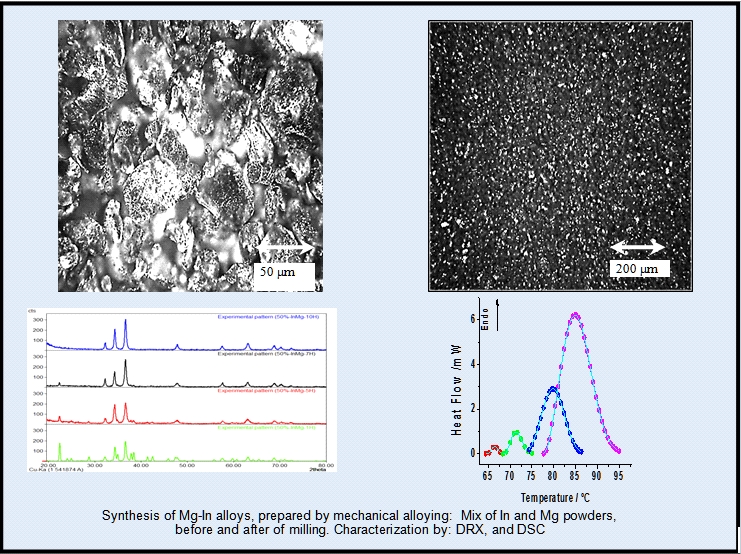
We synthesized two Mg-In alloys, namely, Mg 50% In (17.47% at. In) and Mg 75% In (38.84% at. In) by subjecting high purity Mg and In powders to mechanical alloying. The synthesis was followed in each case by X-ray diffraction (XRD), which allowed for the identification of a series of Mg-In metastable phases that occurred during the alloying process. The invariability of the diffraction patterns made it possible for the grinding time to be set at 10 hours, phases In0.144 Mg1.856 and In0.212 Mg 1.788 and phases InMg and InMg3 having the greatest presence in the Mg 17.47% at. In and Mg 38.84% at. In alloys, respectively. Samples thermally annealed at 300 and 400 ºC were studied by differential scanning calorimetry (DSC) and electrical resistivity (Dr). DSC measurements showed a series of endothermal phases according to what is established in the phase diagram of the Mg-In system. A kinetic analysis of the first reactions in both alloys after annealing at 300 ºC evinced that they occurred by indium diffusion in the Mg matrix. When the annealing was at 400 ºC, however, above the solubility limit of both b1 in the case of Mg 17.47% at. In; and b2 in that of Mg 38.84 % at In, reactions revealed low activation energy, mainly due in the first case to the migration of In atoms in the Mg solid solution, and to the order-disorder transition effects in the second. This behavior was ratified by Ap measurementsDownloads
Download data is not yet available.
Downloads
Published
2020-04-27
How to Cite
Luiggi Agreda, N. J., Rondón, M., & Valera, M. (2020). SYNTHESIS AND CHARACTERIZATION OF Mg-In ALLOYS (17.47% AT. AND 38.84% AT.) PREPARED BY MECHANICAL ALLOYING. LatinAmerican Journal of Metallurgy and Materials, 15–35. https://doi.org/10.5281/zenodo.7693707
Issue
Section
Regular Articles
License
The authors of papers accepted for publication by the RLMM, should recognize the complete transfer of copyright (in all languages) to the RLMM. This transfer includes the right by the RLMM to adapt the article for digital or printed reproduction without altering the written content and information displayed in tables or figures within. The authors retain the copyright and guarantee the journal the right to be the first publication of the work as well as licensed under a Creative Commons Attribution License 4.0 Internacional (CC BY 4.0) which allows others to share the work with an acknowledgment of the authorship of the work and the initial publication in this journal.


