
VISCOELASTIC CHARACTER OF THE AA6061 ALUMINUM BY EFFECT OF THE TEMPERATURE AND THE MICROSTRUCTURE, CHARACTERIZED BY ELECTRICAL RESISTIVITY, MICROSCOPY AND QUANTITATIVE MODELS
DOI:
https://doi.org/10.5281/zenodo.8217747Abstract
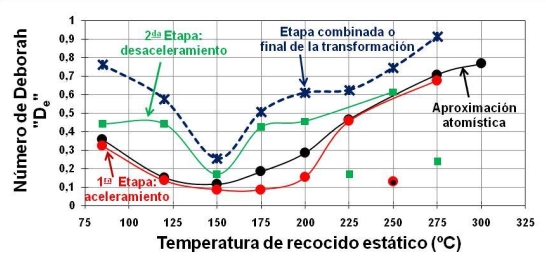
The action of the temperature generated phase transformations in the AA6061 aluminum that caused deformation and relaxation in the microstructure. These effects have been quantified by electrical resistivity, and identified and characterized by microscopy and quantitative models. Four regions were established: I: 20-190, II: 220-420, III: 420-520, IV: > 525 ºC, with activation energy: : 0.22-0.66, : 0.99-1.32, : 4.40-5.17 eV/at., associated to diffusion of mono and di-vacancies, migration and link of solute atoms, diffusion of Mg and Si in Al. Microscopy revealed grain boundaries, nanometric precipitates, and acicular and cylindrical phases. The rheological events showed stages of acceleration, deceleration and stationarity. A number of Deborah, De < 1, which defines the viscoelastic character of the alloy was determined. Between 85 and 200 °C it was determined that 0.1 ≤ De ≤ 0.3, indicating high diffusion, with maximum reaction rate at 150 °C. The quasi-linear model fitted satisfactorily, expressing quasi-statics mechanical phenomena. This model can quantify deformation, resistivity by deformation and by deformations imposed.Downloads
Download data is not yet available.
Downloads
Published
2017-08-15
How to Cite
Ochoa M., J. L., & Arias P., A. R. (2017). VISCOELASTIC CHARACTER OF THE AA6061 ALUMINUM BY EFFECT OF THE TEMPERATURE AND THE MICROSTRUCTURE, CHARACTERIZED BY ELECTRICAL RESISTIVITY, MICROSCOPY AND QUANTITATIVE MODELS. LatinAmerican Journal of Metallurgy and Materials, 195–218. https://doi.org/10.5281/zenodo.8217747
Issue
Section
Regular Articles
License
The authors of papers accepted for publication by the RLMM, should recognize the complete transfer of copyright (in all languages) to the RLMM. This transfer includes the right by the RLMM to adapt the article for digital or printed reproduction without altering the written content and information displayed in tables or figures within. The authors retain the copyright and guarantee the journal the right to be the first publication of the work as well as licensed under a Creative Commons Attribution License 4.0 Internacional (CC BY 4.0) which allows others to share the work with an acknowledgment of the authorship of the work and the initial publication in this journal.


