
FACTORS CONTROLLING THE DISTRIBUTION OF ORGANICALLY MODIFIED CLAYS BETWEEN POLYBUTADIENE-RICH AND POLYSTYRENE-RICH PHASES IN THE SYNTHESIS OF HIGH IMPACT POLYSTYRENE
Abstract
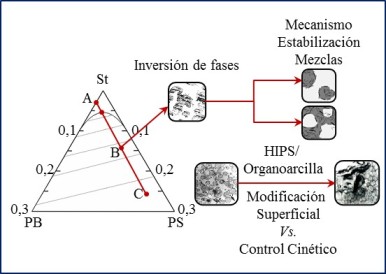
This work investigates the effect of kinetic factors and the surface chemistry of the particles on the dispersion and distribution of clays in heterogeneous system containing polystyrene (PS) and polybutadiene (PB). It was carried out in 2 stages. In the first stage, an isothermal system without copolymer was investigated; that involved simple blends of the mentioned homopolymers, of commercially- modified clays, and of styrene (St) as solvent. In these soft blends, phase demixing was not spontaneous observed, but was induced by centrifugation. After demixing, the composition of the isolated phases was determined by calcination/infrared spectroscopy (FTIR); and in some phases, the clay dispersion was analyzed by X-ray diffraction (XRD). In the second stage, in situ and nitroxide-mediated polymerizations of the St-containing blends were carried out. The incorporation of the organo-clay particles into the different phases and morphology of the rubbery particles of the resulting high-impact polystyrenes (HIPS’s), were observed by transmission electronic microscopy, TEM. The distribution of silicates between the phases was analyzed by calcination/FTIR. In all the samples (i.e., in those of simple blends and in those with polymerization), the clay was mainly incorporated into the PB-rich phase, due to the high affinity between PB and the clay modifiers. In the case of the soft blends, demixing was prevented by the increased stability introduced by the clay; and several mechanisms were proposed to explain such behavior. In the case of the synthesized HIPS’s, their thermal resistances were increased by the presence of the modified clays and by increasing the degree of dispersion of the clay in the polymer.Downloads
Download data is not yet available.
Downloads
Published
2014-07-03
How to Cite
Gando, I., Royett, J., Yañez, M., González, I. M., Inciarte, H. C., & Oliva Bohorquez, H. M. (2014). FACTORS CONTROLLING THE DISTRIBUTION OF ORGANICALLY MODIFIED CLAYS BETWEEN POLYBUTADIENE-RICH AND POLYSTYRENE-RICH PHASES IN THE SYNTHESIS OF HIGH IMPACT POLYSTYRENE. LatinAmerican Journal of Metallurgy and Materials, 95–109. Retrieved from https://rlmm.org/ojs/index.php/rlmm/article/view/566
Issue
Section
Regular Articles
License
The authors of papers accepted for publication by the RLMM, should recognize the complete transfer of copyright (in all languages) to the RLMM. This transfer includes the right by the RLMM to adapt the article for digital or printed reproduction without altering the written content and information displayed in tables or figures within. The authors retain the copyright and guarantee the journal the right to be the first publication of the work as well as licensed under a Creative Commons Attribution License 4.0 Internacional (CC BY 4.0) which allows others to share the work with an acknowledgment of the authorship of the work and the initial publication in this journal.


