
STUDY OF THE FRETTING WEAR OF A DUPLEX COATING DEPOSITED ONTO A 7075-T6 ALUMINUM ALLOY
Abstract
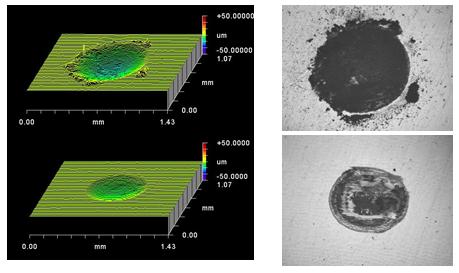
This study was conducted with the aim of determining the response to fretting wear of a 7075-T6 aluminum alloy coated with a NiP/ZrN duplex coating. Initially, polished aluminum alloy samples were coated with an electroless NiP coating having 11 wt% P and 30 ± 6 microns in thickness. Subsequently, a ZrN coating of 3 ± 0.3 microns in thickness was deposited on top of the electroless NiP coating, by means of a closed field unbalanced magnetron sputter ion plating (CFUBMSIP) system. Fretting tests were performed on both coated and uncoated samples of the 7075-T6 alloy substrate. A WC-Co ball 6 mm in diameter was used as a static counterpart and the tests were carried out in air without lubrication. A frequency of 30 Hz was employed for various fretting amplitudes (between 50 and 250 microns) and the number of cycles was set between 104 and 105, respectively. The applied normal load values varied between 25 and 75 N. The wear volume values were obtained by carrying out a numerical integration of the wear scars profile employing a cubic spline function. The morphology of the scars was analyzed by SEM coupled with EDS, which allowed the evaluation of the wear mechanisms. It was found that for the extreme conditions employed during the "fretting" tests (i.e. 105 cycles, 250 microns amplitude and 75 N normal load), the duplex system showed an increase of 28% in the wear volume value (4.9 x 10⁻² mm3) in comparison with the wear value corresponding to the uncoated aluminum substrate (3.8 x 10⁻² mm3), indicating an abrasive wear mechanism.Downloads
Download data is not yet available.
Downloads
Published
2012-10-01
How to Cite
Moreno, E. T., Carrasquero, E., Santana, Y., La Barbera, J., Puchi Cabrera, E. S., & Staia, M. H. (2012). STUDY OF THE FRETTING WEAR OF A DUPLEX COATING DEPOSITED ONTO A 7075-T6 ALUMINUM ALLOY. LatinAmerican Journal of Metallurgy and Materials, 292–307. Retrieved from https://rlmm.org/ojs/index.php/rlmm/article/view/329
Issue
Section
Regular Articles
License
The authors of papers accepted for publication by the RLMM, should recognize the complete transfer of copyright (in all languages) to the RLMM. This transfer includes the right by the RLMM to adapt the article for digital or printed reproduction without altering the written content and information displayed in tables or figures within. The authors retain the copyright and guarantee the journal the right to be the first publication of the work as well as licensed under a Creative Commons Attribution License 4.0 Internacional (CC BY 4.0) which allows others to share the work with an acknowledgment of the authorship of the work and the initial publication in this journal.


