
METALLURGY OF DISSIMILAR STEELS WELDED UNIONS (ASTM A240–A537) AND MECHANICAL BEHAVIOR UNDER MONOTONIC AND CYCLIC LOADS
Abstract
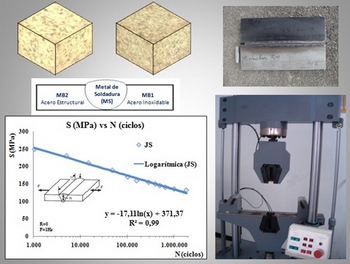
The research shows the characterization of mechanical properties in dissimilar steel welded unions: a structural steel (ASTM A537/A537M:95) butt welded with austenitic stainless steel 304L (ASTM A240/A240M:01) through semiautomatic electrical arc welding process protected by inert gas (GMAW); Argon was used as a protecting gas and austenitic stainless steel ER308L as a supplier material (ANSI/AWS A5.9/A5.9M:2006). Samples were tested in unwelded conditions to characterize the materials involved in the investigation, and they were also tested in welded conditions, not being submitted to pre and post welding thermal treatment. Welded-based material samples were characterized through optical microscopy (OM), an inspection of nondestructive testing (NDT) with penetrating liquids and ultrasound were also conducted. The following mechanical tests were completed, not only on the base metals but on the welding as well: Vickers micro hardness profile, traction, Charpy impact, bending test (face and root), and axial fatigue. Results showed a proper mechanical steel behavior, welded by GMAW procedure, under monotonic and cyclic loads, in spite of they showed high values of micro hardness in the heat affected zone (HAZ), mainly in the proximity of the fusion line between the welding cord and the stainless steel 304L, as well as inclusions between the structural steel and the stainless one.Downloads
Download data is not yet available.
Downloads
Published
2011-05-24
How to Cite
García Fuentes, A. L., Centeno, L., Salas García, R. D., & Velazquez Del Rosario, A. (2011). METALLURGY OF DISSIMILAR STEELS WELDED UNIONS (ASTM A240–A537) AND MECHANICAL BEHAVIOR UNDER MONOTONIC AND CYCLIC LOADS . LatinAmerican Journal of Metallurgy and Materials, 36–48. Retrieved from https://rlmm.org/ojs/index.php/rlmm/article/view/113
Issue
Section
Regular Articles
License
The authors of papers accepted for publication by the RLMM, should recognize the complete transfer of copyright (in all languages) to the RLMM. This transfer includes the right by the RLMM to adapt the article for digital or printed reproduction without altering the written content and information displayed in tables or figures within. The authors retain the copyright and guarantee the journal the right to be the first publication of the work as well as licensed under a Creative Commons Attribution License 4.0 Internacional (CC BY 4.0) which allows others to share the work with an acknowledgment of the authorship of the work and the initial publication in this journal.


